The Apple Ultrathin: Who's Driving the Innovation Now?
· Originally published on OLPC News
The first manufactured computer to ship without a floppy drive was the original candy colored iMac, back 1998, which relied only on internet, a CD-ROM and a port called the Universal Serial Bus ports.
Ten years ago, a cd burner was something expensive, few people had heard of USB connections and the keychain flash drive wasn't coming to market for another two years. This move was considered highly ahead of it's time for apple and for some this helped launch the USB as a standard and displace the 3.5" disks onto oblivion.
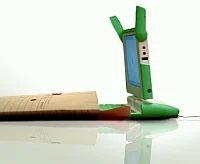
Fast forward to 2008 and Apple announced the wireless Macbook Air, a ultralight low power laptop with no cd or dvd drive, no hard disk, but highly connected portable computer. In a few years this will probably be the industry standard, but this time around it's not Cupertino who's setting it.
Granted, one cannot compare the $199 XO to a $1,799 Macbook anymore than one can compare the recently announced $2,500 Nano Car by India's Tata motor to a $50,000 Porsche, unless on technological grounds. And that is what I'm going to do.
Apple Macbook Air vs. OLPC XO-1
By using cutting edge technology, the Negroponte's team was able to come out not with a dumbed down version of a commercial laptop but a innovative product that was also cheap. The XO was the first portable rely solely on solid state drive and following it's steps came the classmate, the Eee pc and now the Macbook Air.
The XO stills sets some standards that are sure to be followed by the big players. The screen technology for example is certainly – as Lou Jepsen has said – to become a trend. The Apple iPhone is probably the only other product that can be compared in terms of screen resolution and I would not be surprised if their laptops upgraded to 144 dpi displays soon.
And I could bet that mesh networking is the next XO technology to come to a general consumer product. Of course this is not to say that other industries are copying the XO innovations but this is rather a consequence of bigger trends (like falling flash drive prices) that OLPC happened to catch first.
What this does means is that probably all this incredible "clock-stopping hot" technology the little green laptop has today will probably be quite common place by the end of 2008. And by then, what will happen to the One Laptop?
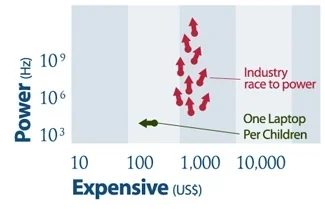
Price vs. Power Future
By there we can expect Apple, Eee, Dell and every other computer manufacturer to have updated their computer models. Prices may go down a bit, but muscles will surely go way up. What can we expect from OLPC?
I hope XO2 to continue forcing the biggest innovation on the computer industry so far: that muscles might go up a bit, but price – oh price – will continue to drop radically.
Let all the computer manufacturers continue their Arms Race. Let OLPC step outside to another completely different kind of marathon.
The one for the children.